These are the winners of the Flemish Woodworking Competition
Text and images Embuild
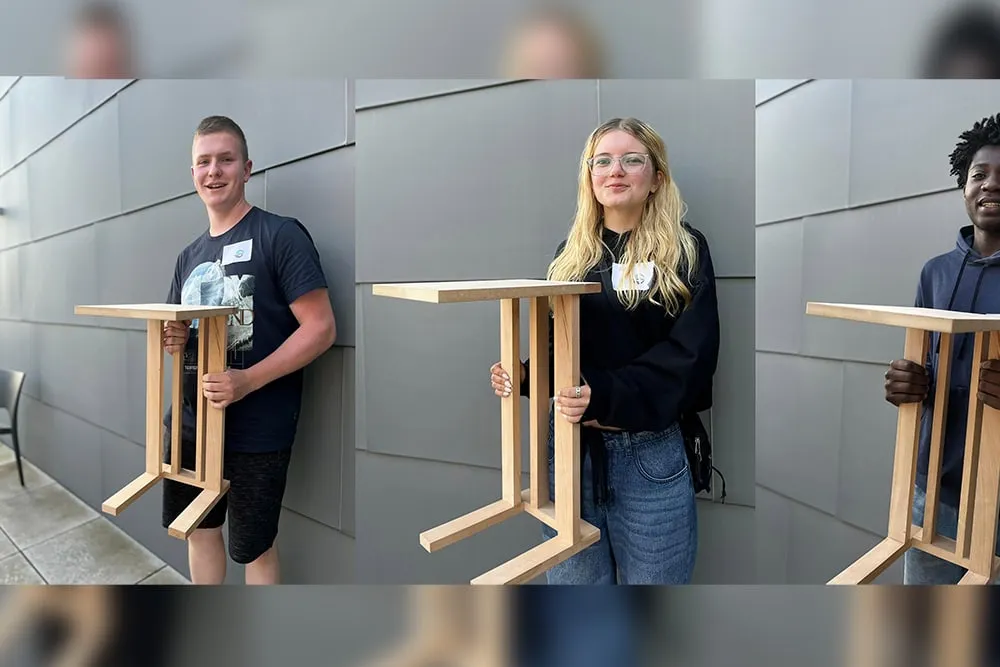
The winners of the Flemish Woodworking Competition have been announced. This year, 941 pupils from 65 schools across Flanders took part in the country’s largest joinery competition. Arwen Debecker from Atheneum campus Louis Zimmer in Lier (TSO), Sjors Branten from Talentenschool Turnhout (BSO) and Kelvin Adjetey from SBSO Zonnegroen Zoutleeuw (BuSO) were crowned winners. With the competition, Embuild Vlaamse Schrijnwerkers aims to draw attention to the declining number of woodworking courses in Flemish schools, while the labour market is crying out for skilled tradespeople.
The concept behind the Flemish Woodworking Competition is simple. In the morning, pupils are given the plans for a piece of work, an irregularly shaped wooden table, which they must complete by the evening. The furniture is designed to require pupils to apply various woodworking techniques, both by hand and using machines, and to work with different types of wood. A jury of experienced joiners then assesses the pieces and names a winner in each study track (BuSO / BSO / TSO). This year’s winners are:
TSO
1. Arwen Debecker, Atheneum campus Louis Zimmer Lier
2. Everaert Senne, Richtpunt Campus Eeklo
3. Kyandro Voorpyl, Mosa-RT Maaseik
BSO
1. Sjors Branten, Talentenschool Turnhout
2. Anthony Vanhoorebeke, Richtpunt Campus Eeklo
3. Szymon Podgórny, Mosa-RT Maaseik
BUSO
1. Kelvin Adjetey, SBSO Zonnegroen Zoutleeuw
2. Luca Van Den Rijken, BuSO Sint-Jansberg Maaseik
3. Nicolas Absalon, BuSO Kristus-Koning Instituut Brecht
Shortage occupation
With this competition, Embuild Vlaamse Schrijnwerkers aims to draw attention to the declining number of construction courses in secondary schools. In mid-February, the Social and Economic Council of Flanders (SERV) noted in an advisory report that education is currently failing to address labour shortages. The number of construction courses is also steadily declining, while schools are offering an increasing number of sports and arts courses. According to SERV, some regions are even facing a shortage of furniture-making and woodworking courses.
The importance of manual skills
Through the Flemish Woodworking Competition, the trade federation for Flemish joiners also wants to send educational institutions a clear message: basic skills such as manual woodworking and hand skills must not be overlooked. The coronavirus pandemic and the widespread use of part-time distance learning meant that pupils missed many practical lessons over the past two years. This is a concern, as pupils’ practical skills have been declining for years. “Pupils of course need to learn how to use machines, but when fitting a window or kitchen at a customer’s home, a joiner must always be able to rely on their craftsmanship to make small adjustments. Manual skills are essential for that,” says the federation. “And we are seeing that pupils on woodworking courses are practising these skills less and less because of the increased focus on machine work.”
Education is therefore failing to meet the needs of the Flemish labour market, which is desperately seeking technically skilled workers. Yet joinery has been a shortage occupation in Flanders for many years. Flemish joinery businesses are struggling to find skilled, qualified staff.
Question about this story? Ask your question
Keep following this
Get an email when a new story is published. No account needed.
- SubjectWoodworking