A robot cell tailored to your production
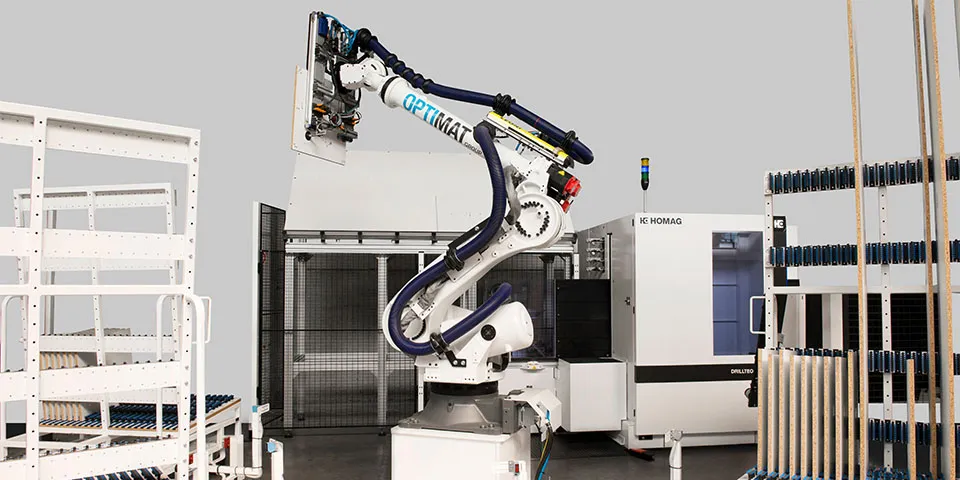
With its robot cell, Vens & Thiers of the Optimat Group has added a new asset to the interior joiner’s workshop. The robot enables automatic loading and unloading of, for example, sawing or drilling machines. “The layout and operation are fully tailored to the customer’s wishes and requirements, so the benefits for their production chain are maximised.”
The brand-new Optimat robot cell is on display in the Vens & Thiers showroom. It is one of the latest additions to the range of solutions for automating machine lines. The robot can be connected to a drilling machine, sawing machine or even an edgebander, acting as an automated machine operator.
Various configurations possible
The robot cell installed as a demonstration in the Vens & Thiers showroom loads and unloads a drilling machine. What makes the concept unique is that loading and unloading take place vertically in specially developed sorting trolleys. Components, pre-sorted or not, are placed in the trolleys and loaded into the cell. Sensors ensure that all components are safely removed from the trolleys and transferred to the zero-point table. There, each component is aligned and measured. The barcode scanner integrated into the robot’s nose scans the corresponding machining programme. The robot then positions the components in the machine. Once the programme is complete, the robot removes the components and places them in an empty sorting trolley.
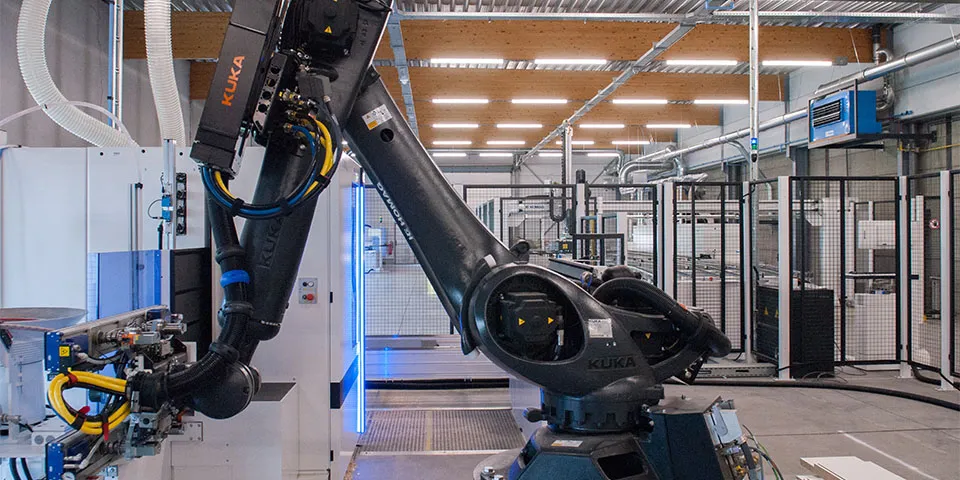
At Kaster Keukens’ production facility, Vens & Thiers configured an unmanned drilling line with horizontal stacks.
“As production here is mainly one-off, and horizontal stacking of workpieces in a wide range of sizes is not always practical, we opted for vertical stacking in sorting trolleys. In this setup, an employee sorts the components into vertical trolleys after the previous machine, the edgebander. At the next stage of production, another employee collects the full trolleys of drilled components in parallel, ready to deliver them in sorted order to the assembly department,” explains Mattias Bossuyt of Vens & Thiers. Four sorting trolleys are positioned in the robot cell. One is empty, ready for the drilled components, while the other three are full. This flow-through system provides autonomy.
Vens & Thiers is known in the sector for its bespoke solutions, and its approach to robotics is no different. The robot’s layout and operation are tailored each time to the customer’s production chain and working environment. “In our example, the robot is in a fixed position and we use sorting trolleys,” Mattias explains. “It is just as possible to use pallets (horizontal stacks) for the production of larger batches. In that case, we might put the robot on a rail, so that more than two pallets are within reach for stacking the machined parts.”

A panel saw ready for unmanned production
For batch or one-off production
There are, of course, several important factors to consider when setting up and programming the robot. One is the volume of identical components. While one workshop may need large quantities of identical parts, another interior joiner may work more often with one-off components. Mattias Bossuyt explains: “In the latter case, we provide a barcode system. Each part is given a unique code. A scanner in the robot’s nose scans the programme for each panel. For more batch-oriented production, bills of materials offer a more practical alternative.”
Once the volumes, stacking method and machine to be connected have been established, the robot cell is built up on a modular basis. In other words, it is tailored to the customer. “That has been Vens & Thiers’ mission from day one,” adds Klaas Lecluyse. “Optima is a good example of that. We developed our first robot configuration at a customer’s request. The sector has changed considerably. In the past, people would simply buy a machine and be happy as long as it was fast. Now, everything around it has become much more important, including ergonomics and efficiency. We look at the whole picture, including training. A robot cell may seem complicated, but we provide a user-friendly HMI (Human Machine Interface, ed.) for operating the robot and explain the basics in an accessible way.”
Question about this story? Ask your question
Companies in this story
Keep following this
Get an email when a new story is published. No account needed.
- SubjectWoodworking
- CompanyOptimat Group