Investing in ergonomics pays off in shorter production times
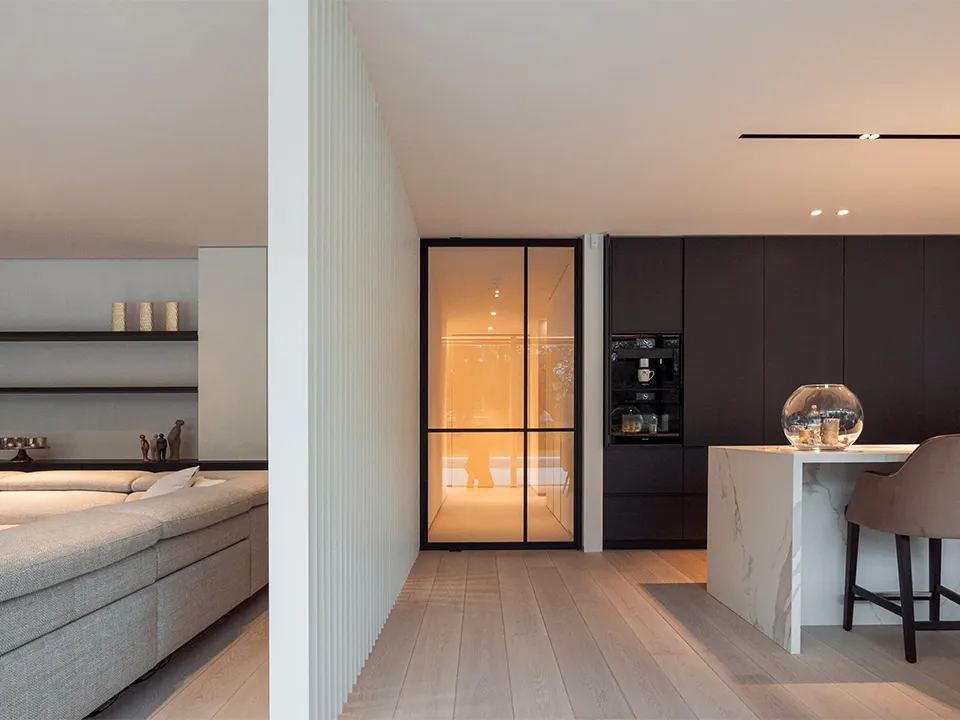
‘The ideal door is no door.’ Or at least not one that feels like a door. That is the motto of Anyway Doors in Massenhoven, whose innovative ideas have brought doors into the 21st century.
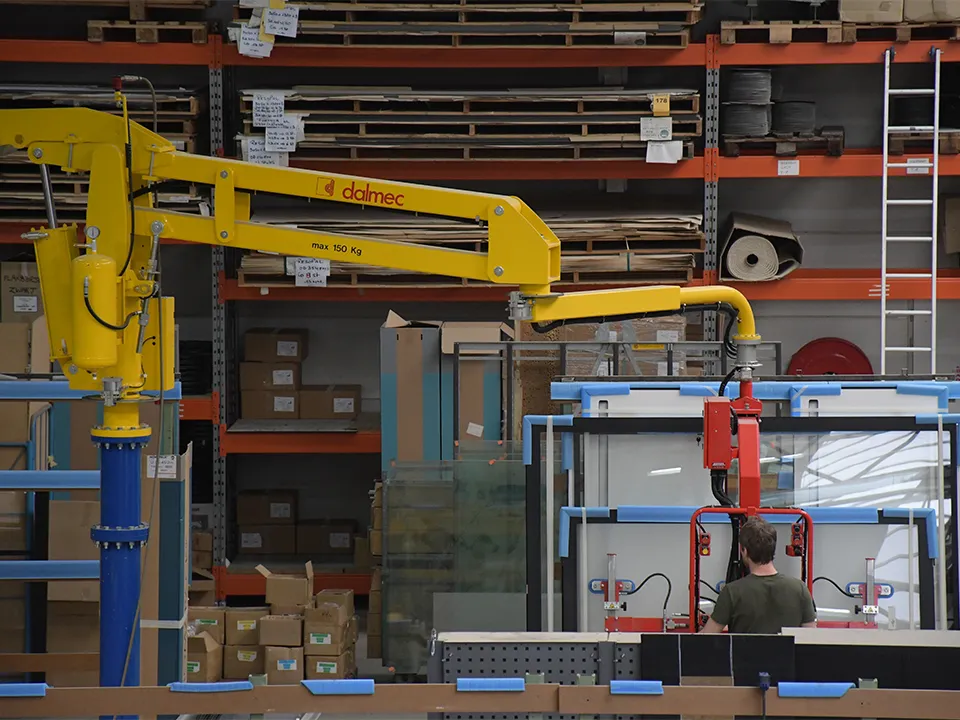
The concepts, already recognised with several international design awards, are developed and manufactured entirely in-house. With a trend towards ever larger, and therefore heavier, products, the company invested in Dalmec pneumatic manipulators to improve ergonomics. This made it possible to adapt almost every workstation that had required two operators so that it could be run by one.
In 2020, it will be exactly 25 years since Rudi Dries came up with an innovative door concept. The idea was to make the door as invisible as possible while integrating it aesthetically into the space. COO Thomas Lierman says: “Next year, we’ll launch the eighth generation. We want to stand out in the market by continually developing new techniques and reinventing the system. Rudi is still just as passionate about designing the ideal door. He has a drawer full of ideas for adding functionality without detracting visually from the door or the space. By bringing together a team with backgrounds in architecture and interior construction, we have a great deal of in-house expertise in materials and how they work together in a space.”
36,000 possible door configurations
Its success is therefore no surprise. An average of 120 doors leave the factory every week, mainly for the residential market. “Every door we make is bespoke, even within the same project. We always visit the site, both to take precise measurements and to analyse the space and see how the door will fit into it. Customers can then choose exactly how they want their door finished to a high standard. I think there are around 36,000 possible configurations,” says Lierman. This approach is only possible because everything is manufactured in-house. Behind the 1,000-square-metre showroom is a 3,000-square-metre workshop, where each door is meticulously assembled at different workstations to meet the customer’s requirements. “We seek to improve efficiency by introducing (semi-)automation. This allows us to work faster with as few staff as possible.”
Focusing on ergonomics
Anyway Doors is also keen to use its workforce sparingly. Lierman says: “The large sizes of today’s doors make them difficult to handle and, above all, heavy. Since 2004, we had a system in the workshop with a swing arm, hoist and suction cups to improve ergonomics. But the operators didn’t use it: it wasn’t practical or mobile enough. This physically demanding work would not have been sustainable in the long term, though. We were determined to avoid staff being unable to work and began looking for another solution.” An online search led them to Arcadel and Dalmec’s pneumatic manipulators in 2018. “It was only at Arcadel’s showroom in Roeselare that we really saw how easily these manipulators could be operated with one finger,” says Lierman.
Three manipulators
Anyway Doors immediately ordered three. Lierman says: “At the solid-core panel workstation, the challenge is to remove the panels from an automatic lift system in the limited space available. With Dalmec’s solution, which has a very long arm, we can eliminate several handling steps, saving a significant amount of time. The second manipulator is used to lift glass panels vertically out of the glass rack, lay them horizontally for further assembly and then place them on the buffer line. The manipulator therefore needs to tilt through 180 degrees. Its suction cups are also adjustable, so they can always be positioned correctly, whatever the door design. At the final inspection stage, the manipulator must also be able to rotate fully around its axis so the entire door can be inspected.”
Saving time and costs
There are three different types, but they do have one thing in common. “Each workstation now requires only one operator, and we save time. Quite a lot of time. Another essential requirement for us was that the handling should leave no visible marks. After all, these are finished products. Dalmec had the expertise to achieve this based on our samples. The manipulators can handle loads of up to 150 kilos. Some items sometimes needed four people because of their size. Now the Dalmec manipulators do the heavy lifting. They have made a world of difference to the physical demands placed on our staff. Ergonomics have improved so much that employees with a hip replacement can continue working here. You can see that enthusiasm for this technology is still strong on the shop floor,” Lierman concludes.
Question about this story? Ask your question
Keep following this
Get an email when a new story is published. No account needed.
- ThemeImproving window and door performance
- SubjectProduct information