











Working safely with woodworking machinery through virtual reality
Text Marlies DecavelImage HOWEST
Free VR application for schools
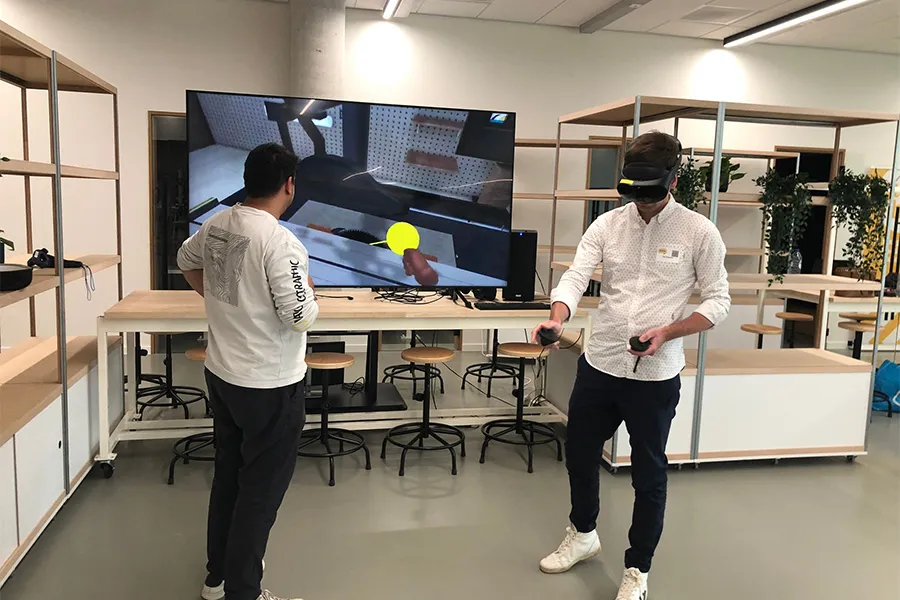
The research and development lab HITLab, affiliated with Howest Kortrijk, focuses on creating proof of concepts. It does this in collaboration with companies and institutions, using new applications to address key needs in the workplace. The education sector asked for an innovative tool to teach secondary school pupils to use woodworking machinery safely and efficiently. This led to Woodcraft VR, a virtual reality application made freely available to secondary schools in Flanders.
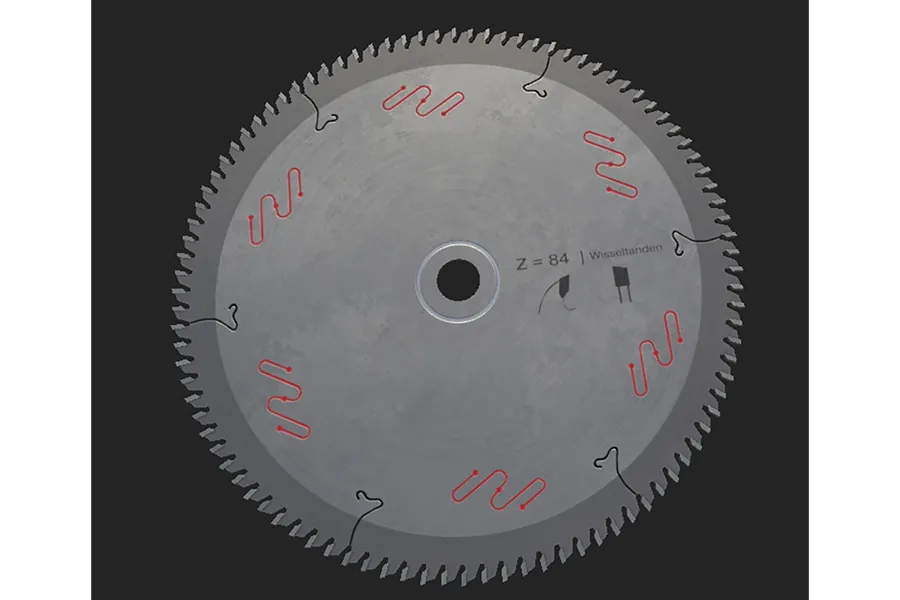
At the Human Interface Technology Lab (HITlab), affiliated with the University of Applied Sciences West Flanders, researchers develop new technological prototypes. The research team works with a range of sectors, including companies and care institutions, and now, for the first time, schools too. Charlotte Larmuseau, a researcher at HITlab, explains: “Campus Engineering Veurne approached us with a request for an innovative training tool for woodworking machinery. Teaching pupils to use the machinery safely and correctly, as well as applying VR, are both part of the curriculum for woodworking courses. It was a very specific request, with a well-developed proposal.
Through the pedagogical support service, we put out a call for interested parties. This led to the formation of a core team with considerable expertise, which supported us in developing this VR application. Thanks to our close collaboration with schools, we developed the project into an InnoVET project: innovative teaching methods for labour-market-oriented courses, with support from the Flemish Government.”
Learning responsibly and independently with Woodcraft VR
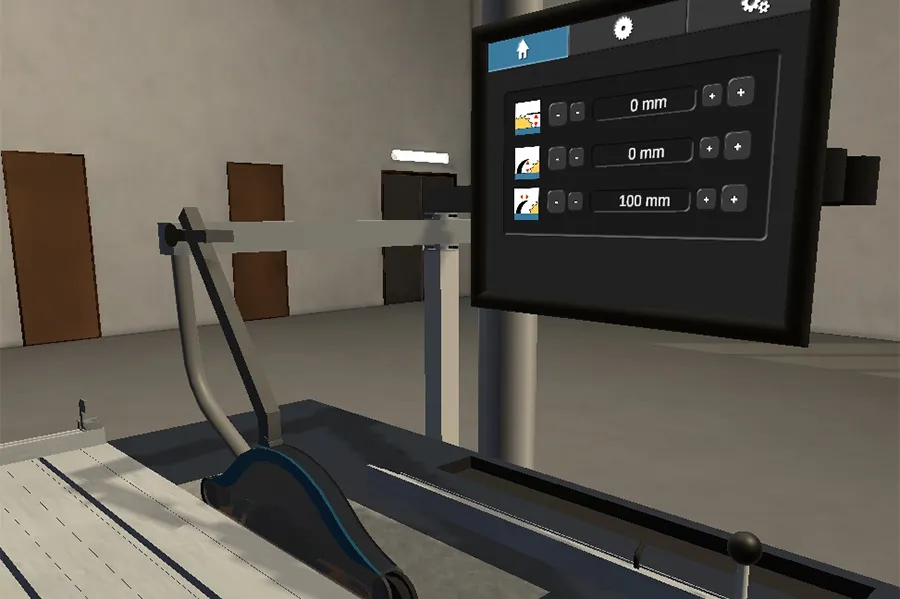
With Woodcraft VR, pupils from the third year of woodworking onwards learn to use a panel saw and a milling machine step by step. A tutorial introduces them to virtual reality and lets them practise using the controllers and a VR headset. Then the training begins in earnest, explains developer Jordy Verbruggen: “It is important to recreate real working conditions as closely as possible. That is why pupils first put on their personal protective equipment: a dust mask, hearing protection and safety glasses. They then choose their machine and practise the operations step by step through a series of logically structured tasks. They receive regular feedback and learn new skills almost independently.”
Charlotte adds: “We deliberately chose this immersive approach to learning. For teachers and pupils, it is a safe way to learn to use the machinery responsibly. Until now, that has often been a major barrier for teachers when it comes to letting their fourteen- and fifteen-year-olds work at the machines on their own. With the VR headsets, you can have ten young people working at once. The teacher and fellow pupils can follow along on screens, learning from one another and giving feedback.”
VR application available free to schools
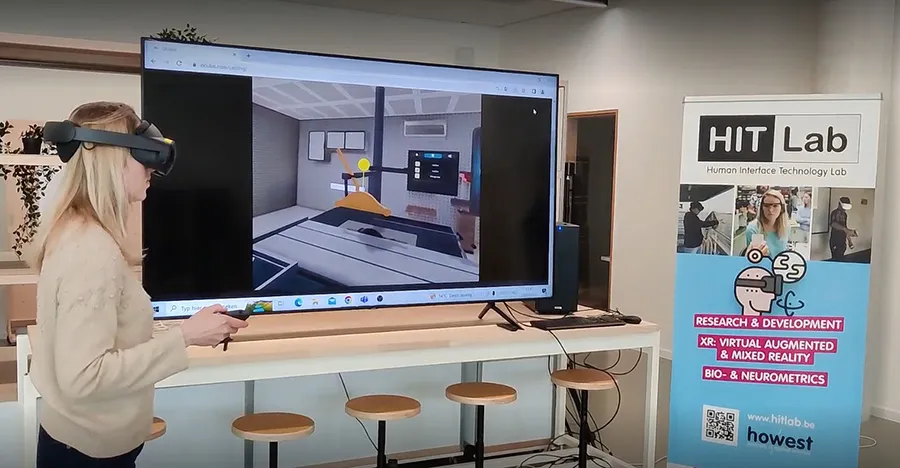
Although VR is used increasingly often, not all schools have the necessary equipment. HITlab is therefore offering the Woodcraft VR application free of charge to secondary schools via Klascement and the app store, while the Regional Technical Centre (RTC) in West Flanders is providing cases, each containing four VR headsets. Charlotte says: “The basic version of Woodcraft VR will be available from September. It contains information about one type of saw and milling machine, including detailed views of different saw blades and so on. However, we aim to expand the tool to include other machines and continue to optimise it. The data we collect through schools enables us to maintain quality control and analyse the learning process. This allows us to make targeted improvements and, in the future, potentially tailor the tool to companies as well. Woodcraft VR could be useful for efficiently training all-round employees: it provides independent training, reduces costs for external instructors and gets employees working on the machines sooner. We see many possibilities. To fund this, however, we are counting on co-financing or the launch of similar programmes. Companies that also see the potential of this project are welcome to contact us.” ■
Our application is now available to download for free via the App Lab: Woodcraft VR on Oculus Quest 2 | Oculus
Question about this story? Ask your question
Keep following this
Get an email when a new story is published. No account needed.
- ThemeEfficient workshop production
- SubjectGeneral







