











WOOD.BE inspires: what are the 9R strategies?
Text Marlies DecavelImage WOOD.BE
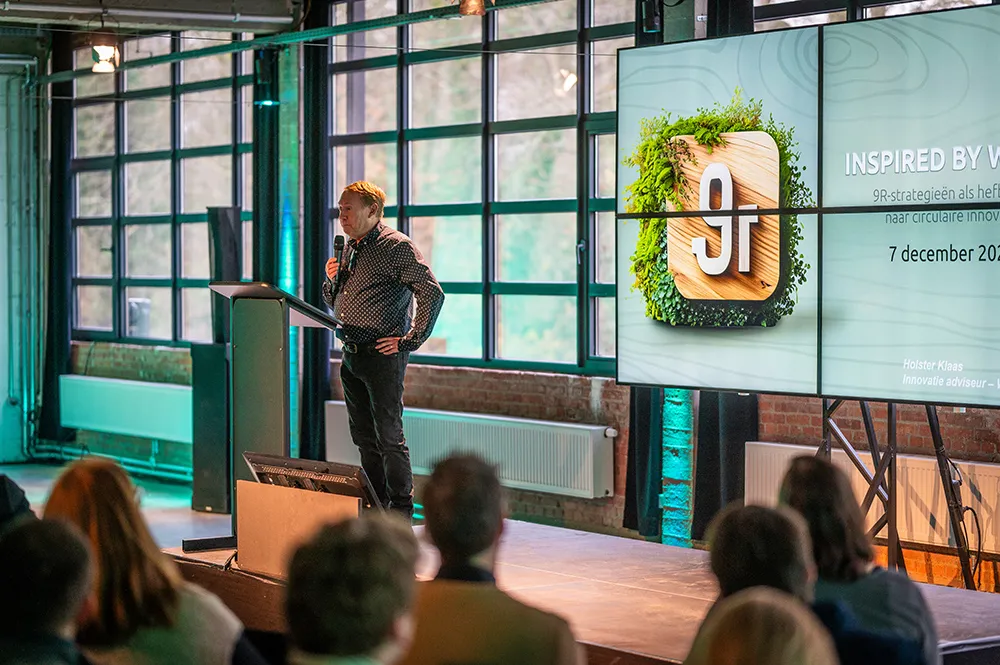
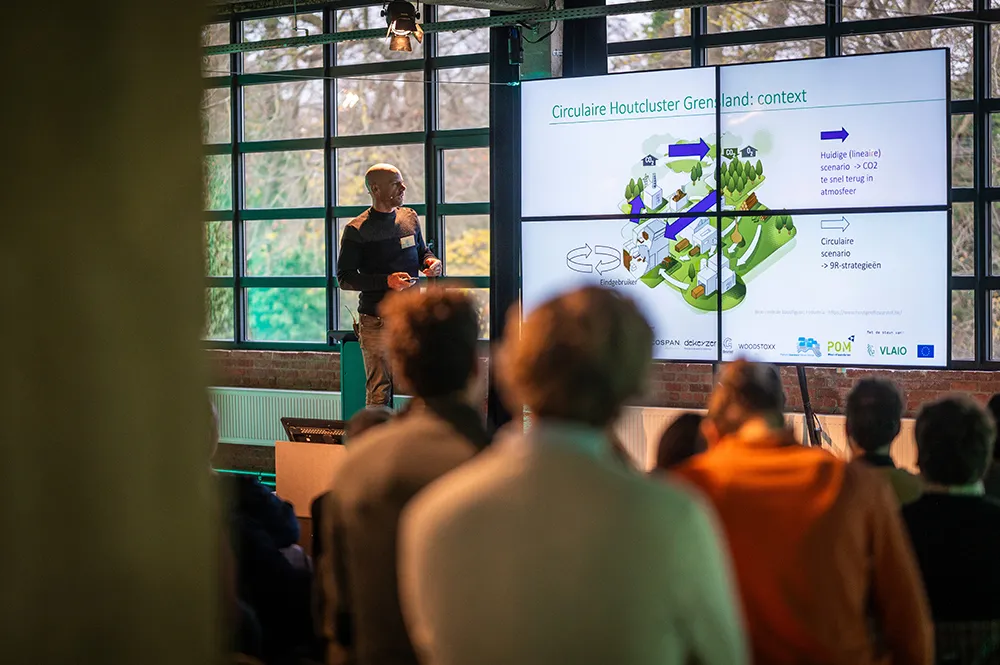
On 7 December 2023, Inspired by WOOD took place, an initiative by WOOD.BE, the knowledge centre for the wood and furniture industry. Using the 9R strategies, professionals from the sector explored the opportunities for doing business more circularly. Four industry partners shared how they are putting words into action through a Living Lab. Then two innovative companies addressed the audience and, to round things off, Dutch architect Daan Bruggink took those present on a journey. By the end, the audience was thoroughly inspired.
“Why am I here?” With this question, WOOD.BE general manager Chris De Roock opened Inspired by WOOD. His answer had everything to do with the event venue: De Bonneterie in Erembodegem. When Chris was about ten years old and living next door, the former hosiery factory Bonneterie Du Parc was a thriving business. Yet today it no longer exists. “How did that happen? That question stayed with me, including during my economics studies,” he explained. “I didn’t find the answer in textbooks, but in the day-to-day work at WOOD.BE. For a company to remain relevant in a changing context, it is crucial to be able to adapt and transform with the times. One of our core tasks is to guide companies in the wood and furniture sector on innovation. Today, that means moving towards a circular economy.”
Changing mindsets with the 9R strategies
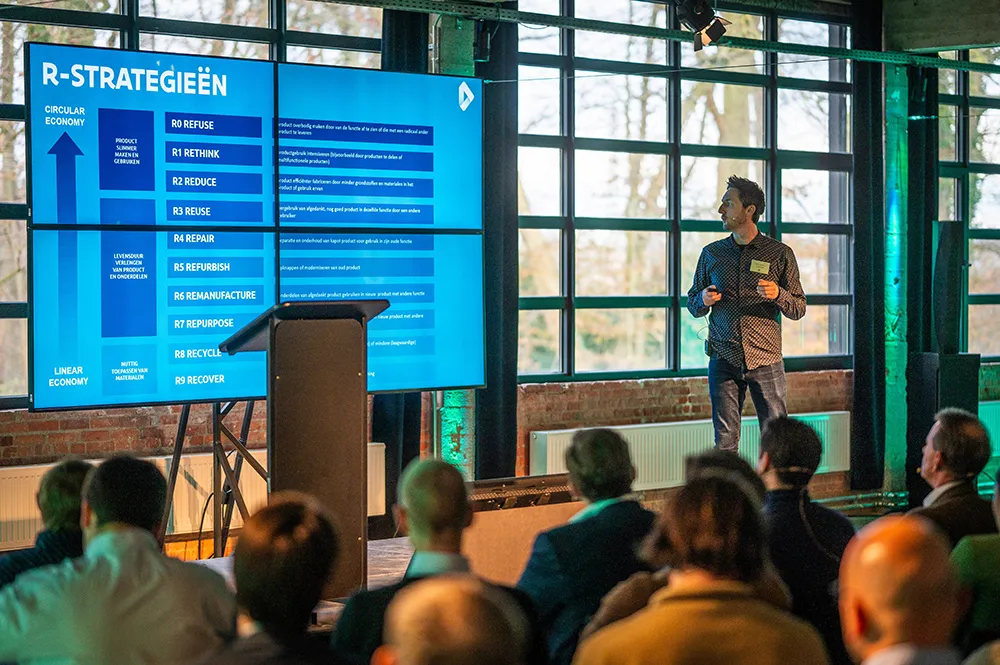
WOOD.BE supports companies in creating an innovative and sustainable future by raising entrepreneurs’ awareness of the context in which their business operates: economic, political, social and environmental. These factors bring challenges such as raw materials, staff, budgets and certifications. “When it comes to circularity, our focus is mainly on creating and retaining value,” said Klaas Holsters, Research & Innovation Expert at WOOD.BE. “We need to make our products smarter, use them more intelligently, extend their lifespan and make the best possible use of them again. That requires a new mindset, in which we think in terms of life cycles and systems and work together along the value chain. One of the most important starting points is to align the life cycle of our wood products with the growing period for quality timber: 80 to 120 years.”
The 9R principles help companies turn sustainability policy from intuitive actions into a considered strategy. “Think of it as a ladder that you try to climb as high as possible. At the bottom is R9: recover. Here, you burn wood waste and use it again as a source of heat or energy. It is easy and cheap, but the wood is gone and the stored CO2 is released. That is a very straightforward route from A to B: linear business, not the ideal solution.” Further up the ladder, in order, are recycle, repurpose, remanufacturing, refurbishing, repair, reuse, reduce, rethink and refuse. “It goes without saying that something you don’t need shouldn’t be made. Plastic straws or a physical answering machine, anyone? By mapping the full life cycle of your product or service as a company, you can see where you stand on the ladder. The higher you are, the more circular you are.”
Sources of innovative inspiration
After several testimonials from West Flanders (see box), three examples of good practice followed. BAO Living was the first to speak. With SAM, a smart, adaptable module, the Antwerp-based company creates compact surface-mounted systems for building services, from ventilation and heating to electricity and water. “With global urbanisation and rising costs, people are increasingly living in smaller homes,” said Benjamin Eysermans, founder and CEO of BAO Living. “SAM creates up to 25 per cent more liveable floor space than conventional designs. Compared with a traditional construction process, it also saves around four tonnes of CO2 emissions through installation alone. Its easy disassembly and efficient use of materials drastically reduce its environmental impact.”
Another example is the circular building materials marketplace. Never heard of one? There’s one in Mechelen: Recuplan. Co-founder Linne Bastiaens explained how it works: “Working with reuse shops and a sheltered employment company, and with support from VLAIO, we process wood waste into high-quality semi-finished products. We’re actively looking for new B2B partners, both to collect raw materials and to process our products. Want to give your wood waste a second life or looking for quality reclaimed timber for your project? You’re very welcome.”
Biophilia is the future
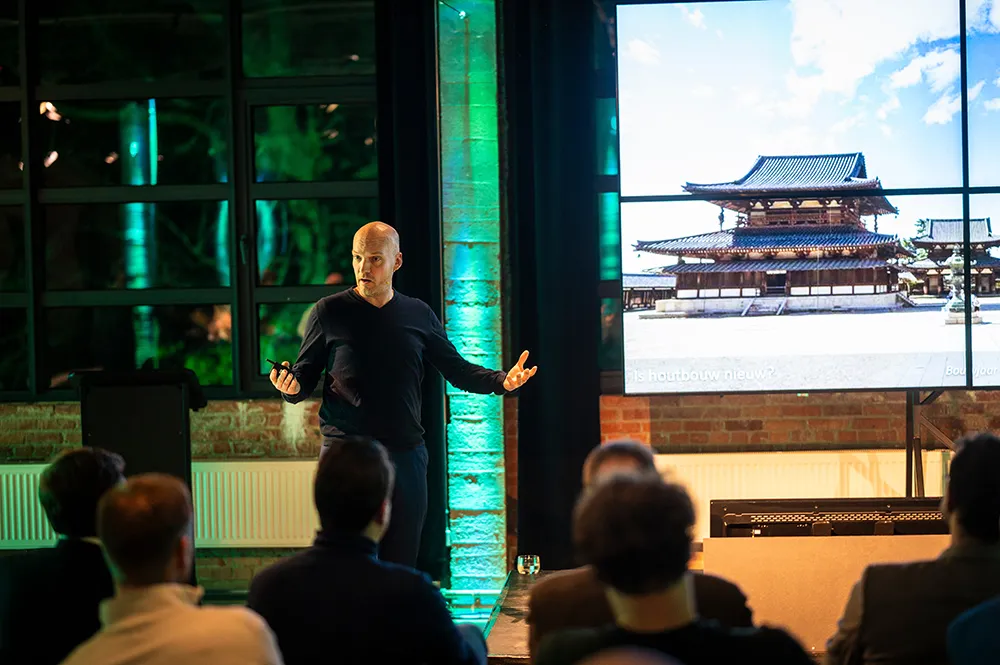
Architect Daan Brugginck travelled from the Netherlands to the Aalst district to explain his vision for construction at ORGA Architect. He questioned the construction sector’s sincerity when it comes to greening the industry. “Are green terraces on apartment buildings really green when you consider that trees need an extensive underground network to grow? Natural building is about direct and indirect experiences of nature, space and place. Natural principles are the starting point, both in terms of form and materials. This contributes to the wellbeing of users and the ecosystem as a whole. Nature-inclusive bio-based construction can save the climate.”
Audience enthusiasm undiminished
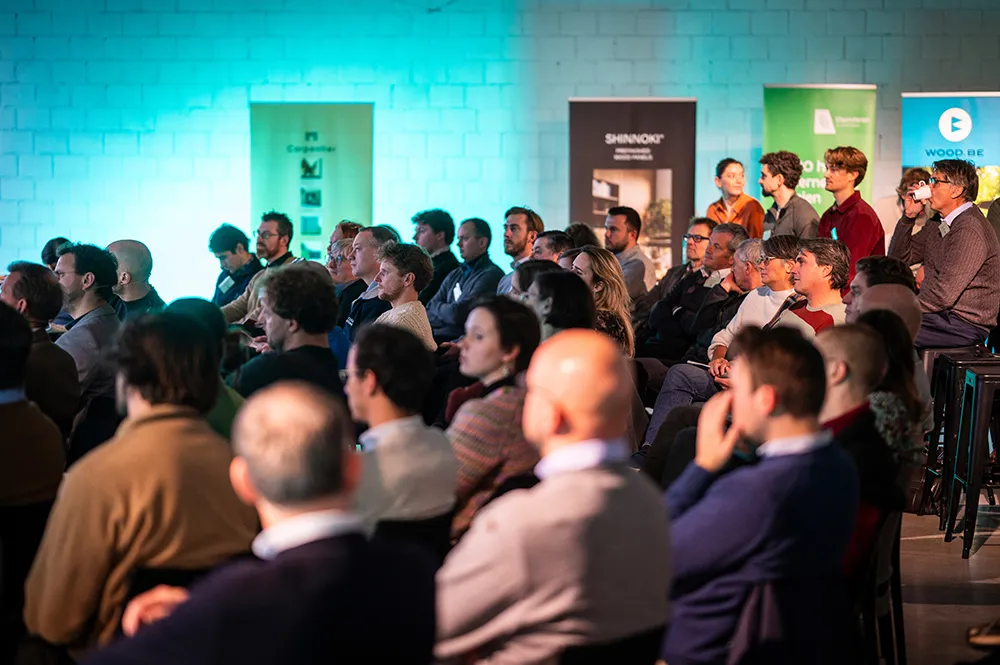
Although the programme ran more than half an hour over time, the audience remained enthusiastic and attentive. Several participants put challenging and passionate questions to the speakers. Once again, this showed how committed the sector is to the transition to circularity. “Will there be enough wood if everyone starts building with timber?” someone asked. “It won’t happen overnight,” architect Daan Brugginck replied. “The transition is taking place step by step. Our products are becoming higher quality, and more and better initiatives are emerging to extend the life of our wood. We’ve already heard about some of them here today. Study days like this inspire people to make the change.”
“How can we accelerate timber construction in Belgium?” was the final question, from the company Carpentier. “Go for it,” came the answer. “Question your production process using the strategies you’ve been given today. Be a frontrunner and inspire others. The sector and the government alike need good examples to see that this is the future.”
Living Labs help companies take concrete action
Through the Living Lab Circulaire Houtcluster Grensland, WOOD.BE encourages businesses to turn circular thinking into concrete action. Together with governments and companies, the expertise centre is working to drive innovation in the sector and contribute positively to Flanders’ climate targets. At the Grensland business park, located in Menen and Wervik, several companies are taking on a three-year challenge to make concrete progress with their circular transition. They are doing so by optimising their products or designing them to close the loop. There is also a strong focus on creating new partnerships, both between companies at the Grensland business park and with the wider wood sector in Flanders.
Decospan
As a producer of finger-jointed veneer, veneered panels, veneer flooring, multilayer parquet and more, Decospan is fully committed to the transition to a sustainable strategy. During its first year in the Living Lab, the company is focusing on reducing and processing its wood waste, while also seeking sustainable alternatives to its existing range. Jonas Feys, R&D & Compliance Manager at Decospan, said: “At the moment, raw materials are the biggest contributor to our CO2 emissions. We’re first looking at the options available for panel materials and bio-based adhesives.”
Group De Keyzer
“Why am I here? That was a good question earlier,” said director Koen De Keyzer, putting the question back to Chris De Roock. “Because it’s our damn duty to run our business in an environmentally responsible way.” Group De Keyzer has set several priorities for the first year of the project. “We’re trying to extend the life of our products, for example by making them more flexible. We’re looking into a solution that would make the niches for built-in appliances adjustable. Appliances are often the first things to break. If the niches can be adjusted, there’s a better chance the kitchen will stay in use for longer. We’re also mapping our residual waste streams so we can manage them more consciously. After a brainstorming session with WOOD.BE and Pilipili, we have plenty of promising avenues to explore over the coming years. I’m very proud of the shift in mindset within our company.”
G. Desmet
G. Desmet specialises in bending solid wood and plywood, and in thermoformed felt for the furniture sector and contract market. For many years, the company has invested in environmentally friendly energy sources such as biomass and solar panels, as well as recycled materials and biodegradable felt. Yet active participation in the Living Lab has revealed many more opportunities. Ward Desmet, Sales & development manager, said: “We explored ways to reduce our wood waste, but haven’t yet found a viable alternative. We have, however, developed a new product that is now on the market: panels made from hemp that can also be used outdoors. We’re also busy testing bio-based adhesives that can withstand the entire bending process. Hopefully that will lead to an aha moment soon.”
Woodstoxx
Since the Living Lab project began, Woodstoxx has been looking at ways to reuse wood waste rather than throw it away. The specialist in selling and installing wooden floors, façades and terraces worked with WOOD.BE to explore how parquet offcuts and short hardwood boards could be put to high-value use again. This has led to some successful results, although the potential for reuse also brings plenty of challenges. “Factors such as origin, discolouration, varying grades and finishes make it difficult to create a consistent product and convince the contract market of its value,” said Yves Lecluyse, R&D manager at Woodstoxx. “We’re continuing our search.”
Question about this story? Ask your question
Keep following this
Get an email when a new story is published. No account needed.
- ThemeSustainable and circular timber supply chain
- SubjectGeneral







