











Official occupational qualifications for the wood sector
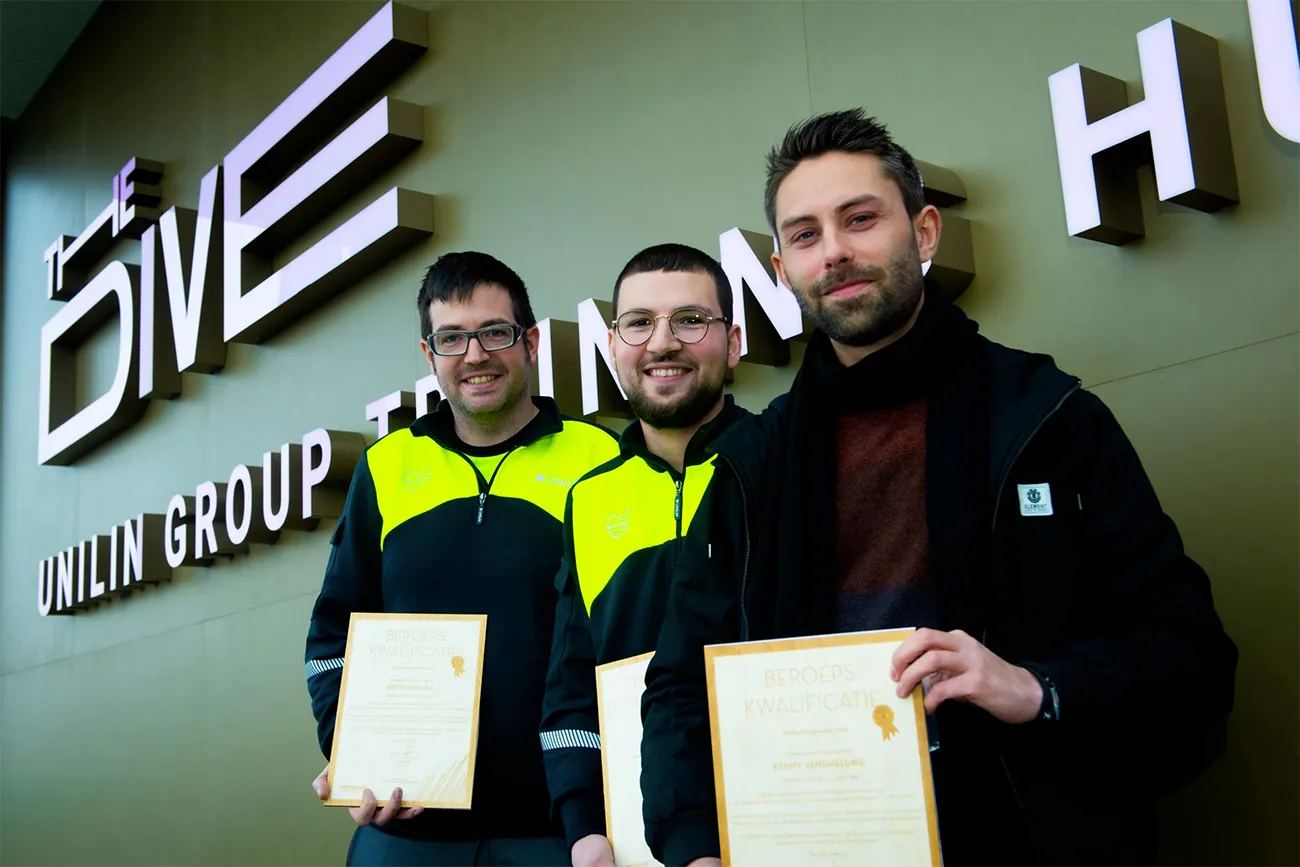
Until now, what employees learn on the job has remained ‘invisible’. This is in a tight labour market where employers are increasingly training their staff on the job. Sector organisation Woodwize is changing that. Together with its partners, it has developed an on-the-job learning pathway that leads to an occupational qualification, which the sector considers equivalent to a diploma. Mathijs, Erwin, Kenny, Pieter and Ali entered the wood sector without a diploma or from a very different background, and were the first to complete the pathway. They can now call themselves fully qualified wood production operators or machine woodworkers.
Last week, at the presentation of the first individual occupational qualifications, Minister Jo Brouns highlighted the importance of this new approach: “Flanders still has a long way to go in lifelong learning and work-based learning. The workplace is Flanders’ biggest school. With these work-based learning pathways leading to occupational qualifications, Woodwize is the first to make this visible.”
Occupational qualification equivalent to other diplomas
Bart De Waele, coordinator of the ESF project ‘WPL4BK: Lifelong qualified work-based learning in the wood sector’, presented the first qualifications to the five pioneers. “Together with the companies Bours, Decadt, De Stoffeerder, Galle houtbewerking, Lenzo and Unilin, social work-based learning centre De Sluis and VDAB, we developed four pathways leading to occupational qualifications, suitable for both large and small companies. We now recognise no fewer than 238 work-based learning modules. Anyone who does not need or have time to complete a full pathway receives a sectoral certificate of competence for the module or modules completed. Thanks to these efforts, 33 people have received qualified training in the workplace over the past two years. Five of them received a full occupational qualification earlier than expected. These are listed alongside other recognised diplomas in the Flemish Government’s LED database (Learning and Experience Certificates). From now on, learning in the workplace counts just as much as learning in the classroom.”
(Self-)confidence for employees and employers
23-year-old Mathijs Guerboo works at Boomzagerij Decadt in Vlamertinge and was the first to gain an occupational qualification as a wood production operator. “This qualification means I can take on a wider variety of tasks. I can now operate, set up and maintain the entire saw line. If the sawmill coordinator is away, I can even take charge.” Company director Stefan Decadt sees qualified employees as a great asset: “The qualification gives me confidence that my employees are well trained and always deliver the required quality.”
External recognition for in-house training
A company such as Unilin, which uses wood as a raw material for some of its products, already had a range of in-house training programmes in place, but has now aligned them with the sector’s expectations. Bart Den Tijn, training manager at Unilin in Wielsbeke: “Our in-house training is now ready to lead to qualifications. That also gives it external value.” The pathway came at just the right time for Pieter Mekeirle, who has a background in the chemical sector. “I want to do my job as an operator well, so it’s ideal to have a plan showing which skills I need to learn at my own pace, with someone following my progress.
This qualification is a welcome recognition of the work I’ve put into retraining,” says Pieter.
A win-win for supported employees and the wood sector
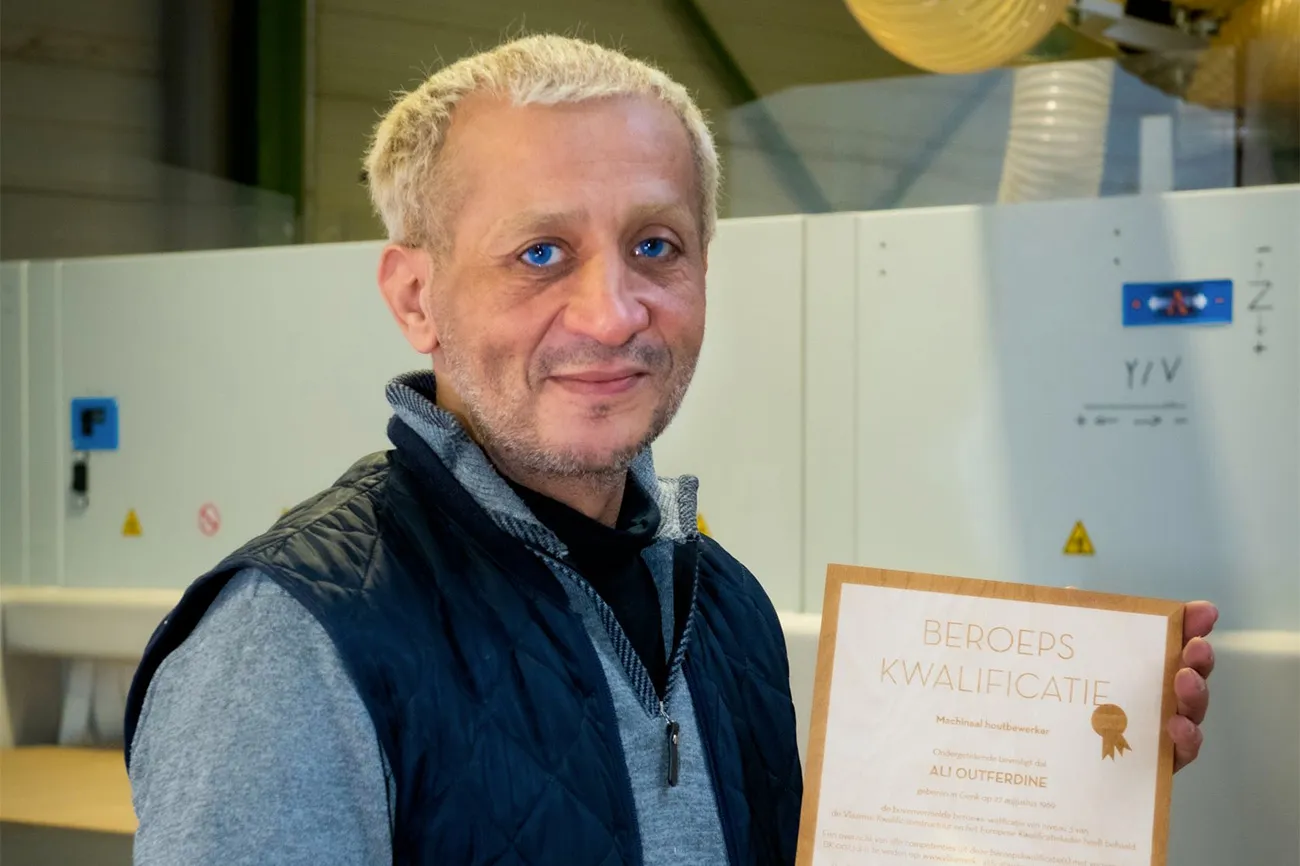
Ali, a supported employee at social work-based learning centre De Sluis in Genk, also learned on the job and is now proud to show off his occupational qualification as a machine woodworker. Kim Cuypers, coordinator at De Sluis vzw: “People in our supported employment department have often graduated from special education and sometimes struggle to find their way. This recognition from the sector gives them an incredible boost.” “When an employer is unsure whether to hire someone, this qualification can tip the balance and persuade them to give it a try,” adds Bart De Waele of Woodwize. “And every employee we win is an asset.”

Strengthening the sector
Employers’ organisations in the furniture and wood sectors are seeing a growing need for work-based learning. “On the one hand, we see a mismatch between education and the labour market. On the other, we know that jobs are constantly changing technologically. Finally, many young people enter the labour market without a diploma. If we strengthen their skills, they can be put to work in our sector very effectively. These three factors make work-based learning indispensable. Through structured, recognised training pathways tailored to learners’ and companies’ needs and pace, we want to nurture this form of learning,” says Wim van Goethem, training and education coordinator at Fedustria. “Supporting this pathway offers a future. The better the training pathway, the stronger the sector. Supporting people in-house is the best school, but by adding external guidance from the sector, we have all the resources we need to guarantee quality in the long term,” adds Pascal Mageren of the Belgian Wood Confederation.
Question about this story? Ask your question
Companies in this story
Keep following this
Get an email when a new story is published. No account needed.
- SubjectGeneral
- CompanyWoodwize







