











Lisocore: You don’t have to be heavy to be strong
Text Anastasia VerleysenImage Lisecore
With more than 75 years of experience, 95 employees and six branches in Flanders and Brussels, VC Wood is a well-established name in the sector. The timber and panel merchant is now also the exclusive distributor in Belgium of the Lisocore lightweight panel. This product is unique in its sustainability, construction and strength.
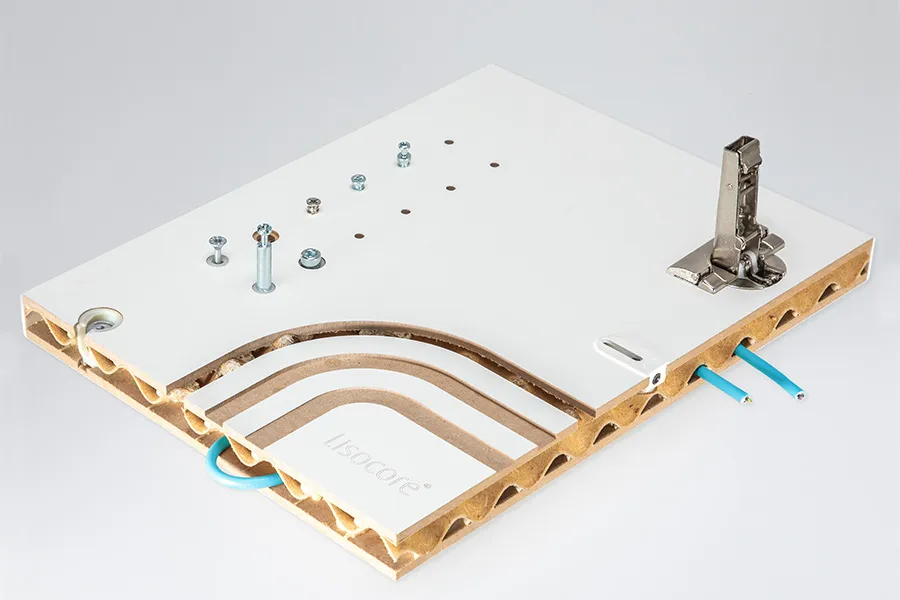
Lisocore is a German, material-efficient, fully recyclable, high-quality construction material. Weighing 350 kg/m³, this lightweight panel is a robust choice for a wide range of projects, including sliding and pivot doors, set and exhibition stand construction, caravans, motorhomes, container construction and tiny houses. It is available in thicknesses of 38, 40, 50 and 60 millimetres and can be processed just like a standard panel. “You can apply edge banding without routing in an additional block,” says Karel Van Cauwenberge, product manager for Lisocore. “You can also bond laminate or veneer to it, because it is strong enough to withstand a press. For fixing, you can’t simply use screws, but you can use a suitable system.”
Sustainability comes first
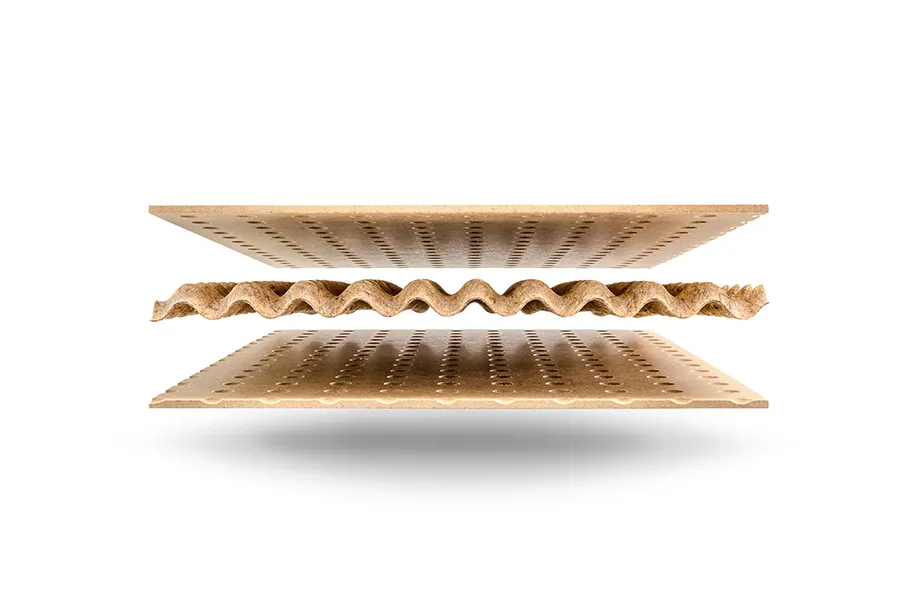
This is not the first lightweight panel, but it is the first of its kind. The organic, undulating structure inside ensures strength, preventing the core from breaking and the panel from warping, as can sometimes happen with a standard panel with a honeycomb structure. “Its stability is assured,” says Karel. “What’s more, electrical cables can easily be run between the undulating structures. That’s important at a time when we need sufficient charging points and LED lights.”
Lisocore is more stable than blockboard, but it is not intended to replace standard blockboard. It mainly offers an alternative to thick chipboard and other lightweight panels. It is lighter, making it easier and more ergonomic to handle. Its environmental benefits are also significant. “It requires two thirds less transport, and the panel itself is material-efficient, using three times fewer raw materials,” says Karel. “The core layer is made from hemp or wood dust, and production uses FSC-certified wood. The very strong adhesive also means less glue is needed, further contributing to sustainability.” ■
Question about this story? Ask your question
Keep following this
Get an email when a new story is published. No account needed.
- SubjectGeneral







