











Impact sound insulation for floating screeds
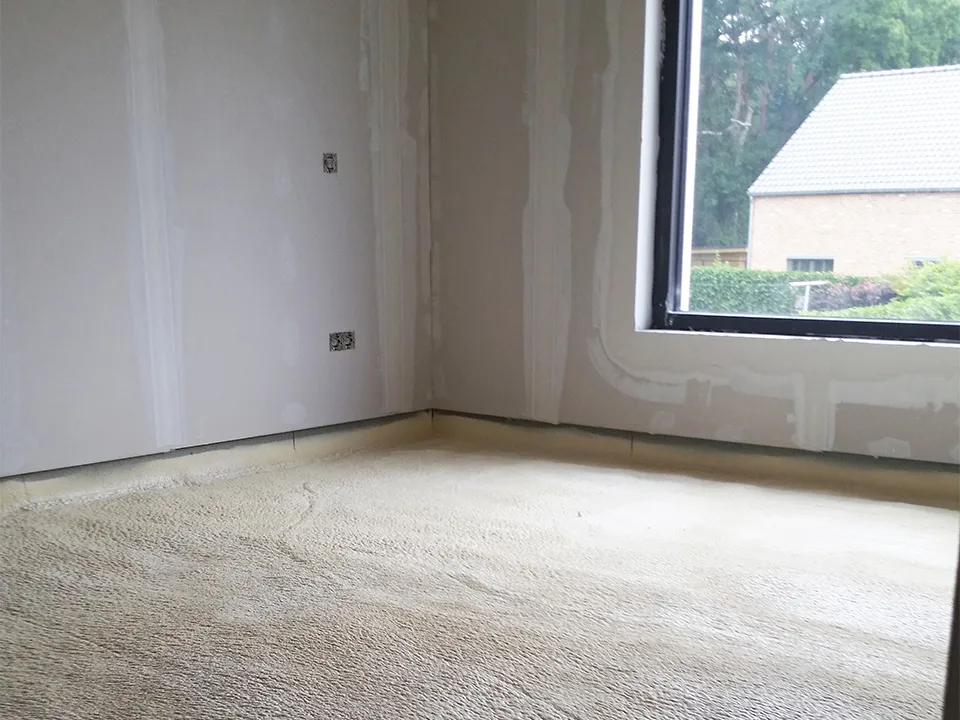
A floating screed construction can incorporate sound-insulating material to reduce impact sound transmission between floors in a building.
Impact sound insulation measurements can be carried out on site or in a laboratory. In either case, the results are representative of the floor build-up used, not of the individual insulation product.
Laboratory measurements can be useful for comparing insulation materials and using them in calculation models. In practice, however, sound is also transmitted via flanking walls and ceilings. The impact sound level measured on site in a building will therefore generally be higher than laboratory tests predict. The Belgian standard NBN S01-400 sets requirements for the in-situ measurement of impact sound insulation performance. It takes account of both direct sound transmission via the floor and indirect transmission via walls and the ceiling.

In-situ measurements using a tapping machine that produces around 78 dB of sound have demonstrated that Soudafoam SPF A3 can be used to create a floating floor construction. This provides acoustic comfort in situations where the sound source is both inside and outside the dwelling.
Acoustic spray foam
Soudafoam SPF A3 can be applied directly over the floor and pipework, to a maximum thickness of 35 millimetres. The acoustic spray foam also provides good thermal insulation. Need more insulation? Closed-cell spray foam Soudafoam SPF W11 or SPH W2H can be added on top of the SPF A3. These harder foams provide additional acoustic insulation, but the effect is less pronounced than with SPF A3. A winning combination.
The finish floor installed later, usually sand-cement screed, must not come into contact with the walls. To prevent this, a thin layer of SPF 13 can be applied to the bottom of the walls. It is also best to prevent the optional rigid thermal insulation foam from bonding to the walls.
Question about this story? Ask your question
Keep following this
Get an email when a new story is published. No account needed.
- SubjectGeneral







