











Green Deal: much more than a buzzword
Text Tim JanssensImage Green Deal Klimaatbestendige Omgeving
‘Green Deal’ is a term that crops up regularly these days. The European version, launched in 2019, naturally has the widest reach. But since 2016, more than twenty sustainable partnership projects have also been launched in Flanders under the Green Deal banner, involving over 1,900 organisations. We take a closer look at three that directly concern the construction sector, and its future, and contribute to European climate targets.
Circular construction
Facilitating and accelerating the transition to circular construction practices was the aim of the Green Deal Circular Construction, which ran from February 2019 to February 2023 at the initiative of Vlaanderen Circulair, OVAM and Embuild Vlaanderen. Recognising that the materials we use are responsible for a large share of our CO2 emissions, and with the aim of reducing material consumption by 30 per cent by 2030, the initiative focused, among other things, on reusing and maximising the high-quality recycling of construction materials, designing buildings for change, making optimal use of space, and extending the service life of buildings and their materials. More than 360 organisations joined forces in this large-scale public-private partnership to form an innovative learning network and establish circular construction in Flanders. This included setting up a multidisciplinary research group, Proeftuin Circulair Bouwen, to remove the remaining barriers.
Mission accomplished? Yes, in many ways. It would be an overstatement to say that circular construction is mainstream in 2025. However, there is now broad agreement that it will become the standard in the longer term. The Green Deal was a valuable first step, providing a wealth of knowledge and lessons, and delivering practical results, including 164 unique pilot projects. For many companies across the wider construction sector, this partnership marked the start of, or gave further impetus to, a deep commitment rooted in the principles of the circular economy. There is undoubtedly more to come …
Climate-resilient environment
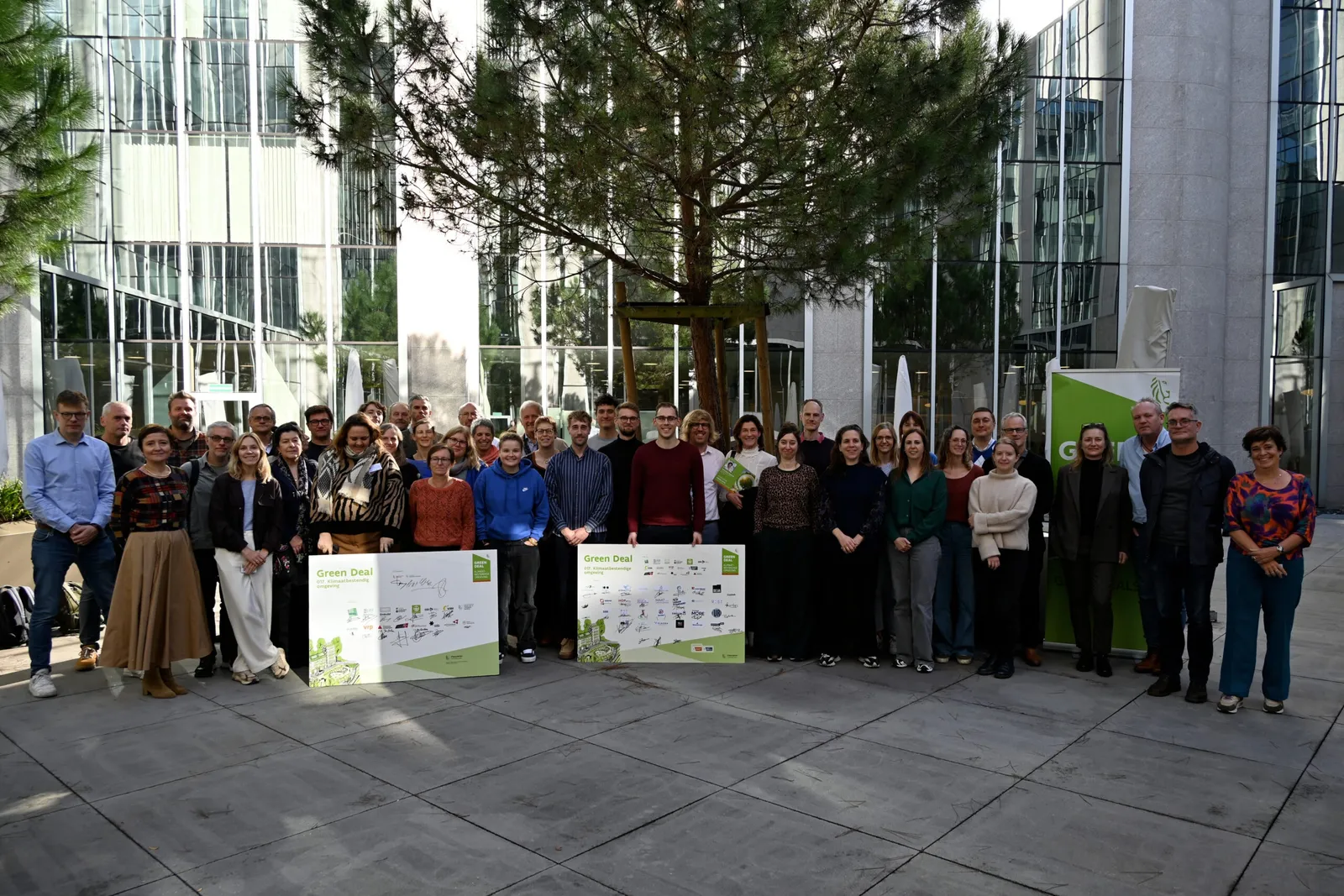
How can we all make smart use of space to protect Flanders from the effects of climate change and biodiversity loss? That is the key question behind the Green Deal Climate-Resilient Environment, launched in January 2024. Here, too, the effects of climate change and biodiversity loss are closely linked to spatial development, which has been the subject of debate for years. The idea, therefore, was to work across sectors to scale up sustainable best practices and feed them into policy. Numerous government bodies, including the Department of Environment, the Flemish Environment Agency (VMM), Bond Beter Leefmilieu, VIBE, ORI, VLARIO, Embuild Vlaanderen and Buildwise, joined forces with more than 130 other participants. By January 2027, we will know whether this Green Deal has achieved its goal.
Local timber
The latest Green Deal, number 22 in the series, has been focusing since 26 September 2025 on the sustainable production, processing and use of local timber as a valuable resource with environmental, social and economic benefits. The challenges are considerable, as the global timber market and primary wood-processing industry are struggling. Establishing and maintaining local timber supply chains in Flanders is no easy task, particularly given growing public opposition to felling trees and a lack of understanding of the economic role of forests. As a result, the number of forest contractors and sawmills continues to fall, and Flemish timber is often exported. Through this Green Deal, the Belgian Wood Confederation, Bosgroepen, the Agency for Nature and Forests, and Fedustria hope, together with 80 other participants, to establish a circular local timber supply chain by September 2028, from forest management through processing to end use.
Question about this story? Ask your question
Keep following this
Get an email when a new story is published. No account needed.
- SubjectGeneral







