











Egbert Lachaert visits Van Hoecke
Innovation is one of the strongest assets of our industry
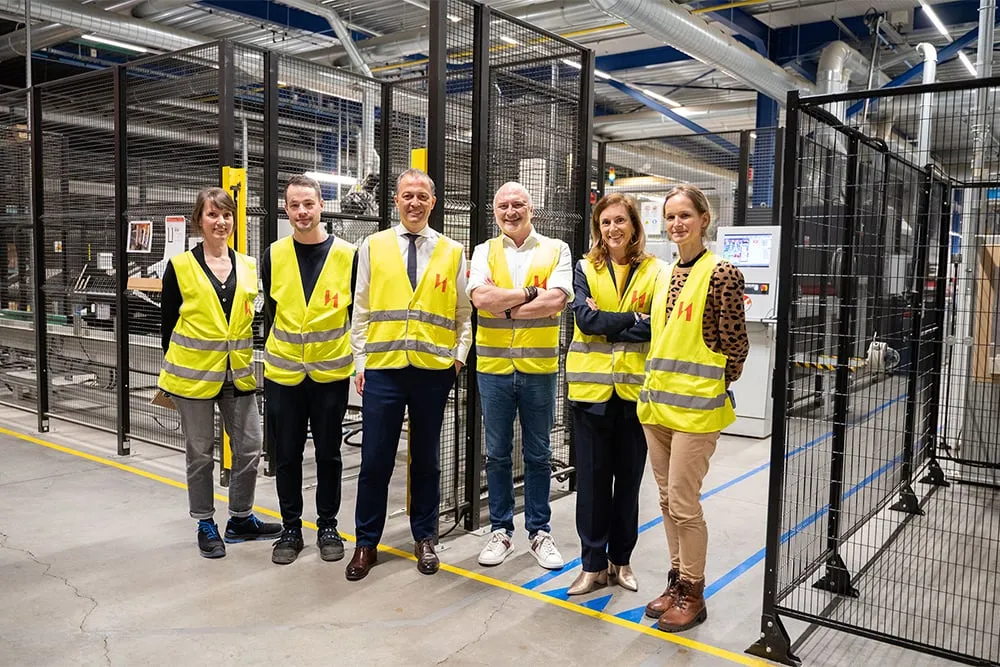
This morning, Egbert Lachaert, second on the Open VLD list in East Flanders, visited family-owned Van Hoecke in Sint-Niklaas, which operates in the furniture sector. The visit was organised at the invitation of Fedustria, the Belgian federation of the textile, wood and furniture industries. Innovation and competitiveness were the focus today. Continuing to innovate is essential to remain competitive internationally and keep growing. Van Hoecke manufactures furniture components for industry and specialist retailers. The company is a leading player in sustainability as well as digital and technological innovation. Van Hoecke has won the “Factory of the Future” award three times.
Industrial policy as the guiding principle for the next term of office
Industry is the backbone of our economy and prosperity. Despite its valuable role, our industry is under growing pressure from rising protectionism, geopolitical instability and increasingly complex regulation. Given the crucial role industry plays in tackling fundamental challenges such as digitalisation and circularity, a resilient and strong industrial sector is essential.
Fedustria is therefore calling for a stronger industrial mindset at every level of government.
Egbert Lachaert: “It is essential that we work together to pursue greater diversification in energy supply. To remain competitive, particularly with our neighbouring countries, we need to keep energy costs under control and avoid adding new policy costs to the energy bills of Flanders’ industry.”
“Our ambition should be to reindustrialise Europe and Flanders as low-carbon, circular economies with healthy trade relations with non-EU countries. Strategic autonomy and affordable raw materials of our own are crucial. We must also protect our capacity for innovation and competitiveness. We therefore call for a new future pact for industry in Flanders: a new long-term vision and strategy to make our industry resilient and agile. This commitment will be at the heart of the first Flemish Industry Summit on 23 March,” says Karla Basselier, CEO of Fedustria.
Innovation is essential to the growth of our businesses and prosperity in Flanders
The wood and furniture industry is an important sector. More than 1,000 companies operate in this segment in Belgium, employing over 17,500 people. Most are SMEs (93%). Together, they generate turnover of more than €6 billion, of which 35% comes from the furniture industry.
These companies are primarily export-oriented, with the furniture industry exporting 65%. International competition is therefore fierce. Our companies need to remain competitive despite the challenges they face, including energy prices, labour costs and raw material prices. Innovative, circular products, backed by outstanding service and support, make the difference. Their business models are constantly evolving.
But they need support and breathing space to do this. “Innovation takes considerable resources. Our companies need to be able to rely on sufficient government support for R&D, through tax incentives and grants without excessive administrative red tape. Continuing to invest in innovation is in everyone’s interest: citizens, politicians and businesses. Without innovation, our companies cannot continue to grow and create prosperity,” says Karla Basselier, CEO of Fedustria.
Family-owned Van Hoecke, a model of innovative and sustainable business
“Innovation is to a business what oxygen is to the body. Without innovation, we suffocate our business fabric and risk bringing everything to a standstill. We must constantly look beyond tomorrow if we are to plan for tomorrow. If we only look as far ahead as tomorrow, we will always be one step behind,” says Peter Van Hoecke, CEO of Van Hoecke. That is why the question “what do we need to do today to remain relevant in 3 years’ time?” is crucial to sound business management focused on continuity across generations. The importance of innovation also increases in direct proportion to the pace at which our society evolves in terms of complexity, technology and digitalisation. Moreover, innovation is no longer an internal business responsibility, but a process that brings together customers, employees and external partners.
Question about this story? Ask your question
Keep following this
Get an email when a new story is published. No account needed.
- SubjectGeneral







