











Construction confidence barometer in the red
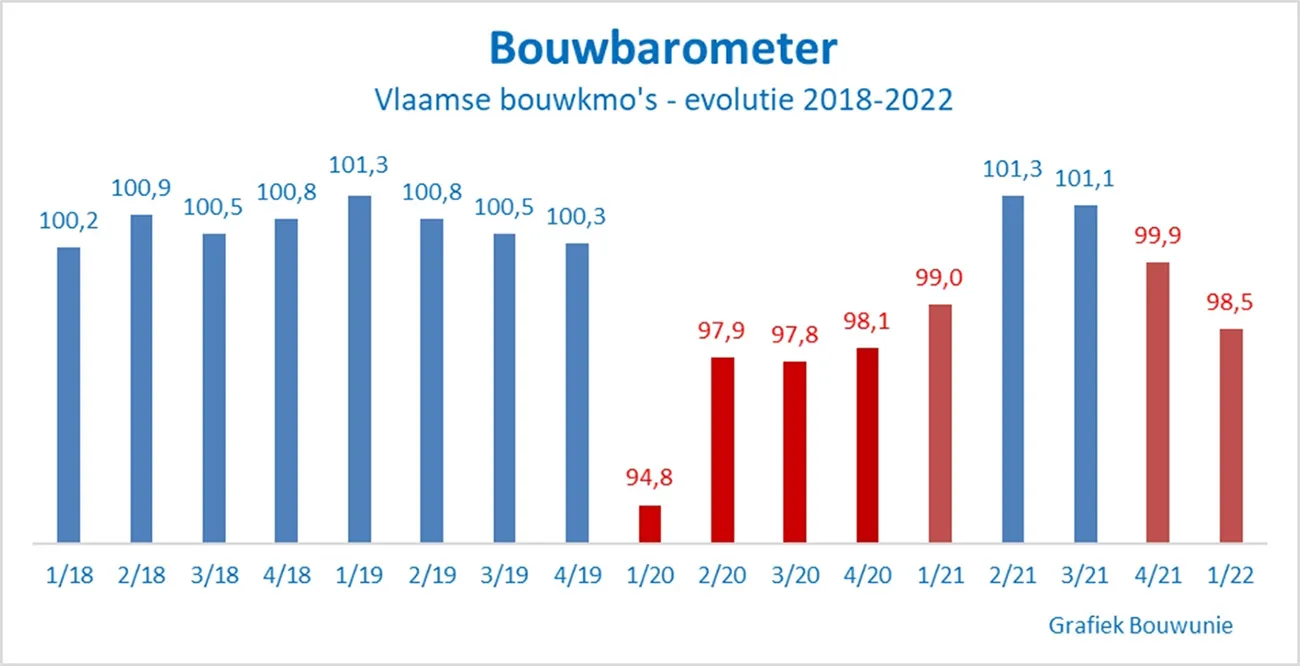
Confidence among construction companies has fallen sharply. This is shown by Bouwunie’s construction confidence barometer, which slipped into the red in the first quarter of 2022. This means construction companies are considerably less positive in their assessment of the economic situation. The soaring costs are, of course, a major factor.
Bouwunie’s construction confidence barometer fell from 99.9 to 98.5 in the first quarter of 2022, slipping further into the red. By comparison, the second quarter of 2021 had still scored a very positive 101.3. The reason is not hard to find: soaring costs and pressure on prices.
Confidence falling
It is worth noting that this construction confidence survey dates from March 2022. But there is no immediate prospect of improvement in the short term; quite the opposite. The many price rises and cost increases are eating into construction companies’ profitability. Four in ten report a further decline. At the end of March, order books were still well filled: one in three construction companies said they had enough work for at least another six months. But if confidence among households and businesses remains as it is today, that could soon change. Uncertainty caused by Covid, the war in Ukraine, supply problems and rising prices is taking its toll. “Prices are rising across the board: timber, insulation, glass, aluminium, concrete,” Bouwunie adds. “The scale of the increase, ranging from 10 to 50 per cent, varies from product to product and supplier to supplier. Another problem is that delivery times are now increasing for almost all materials. Production of some products, such as roof tiles, has even been temporarily suspended. Suppliers are no longer willing or able to provide delivery times. The result is delays and even work sites being shut down. On average, delays are around six weeks compared with the past, although this also varies considerably by product.”
Passing costs on to customers
What does this mean? Increasing numbers of construction companies now have no choice but to pass higher material costs on to customers. In two-thirds of new contracts, higher material prices are passed on to the customer, and this is more often done in full than in part, according to the Confederatie Bouw’s monthly business confidence survey, in which 325 construction companies took part between 9 and 17 May. In 44 per cent of ongoing contracts, construction companies pass higher building material prices on to customers. These price increases are more often passed on in part (27%) than in full (17%). “That figure will continue to rise as long as building material prices keep going through the roof,” says Niko Demeester, CEO of the Confederatie Bouw. “We therefore recommend including a price revision clause in every contract.” This is, of course, increasing uncertainty for clients. In some cases, projects will inevitably be postponed or cancelled. “We are already hearing from the industrial construction sector that a lot of work is being postponed,” confirms FAC, the Federatie Aluminium Constructeurs.

On the ground
Jan Ooms, co-director of construction company and interior fit-out firm Ooms Woonrealisaties: “It is not just material prices themselves, transport and energy surcharges are also major culprits, driving up invoices.” This, together with material shortages and uncertain delivery times, has led Ooms Woonrealisaties to change how it manages stock. “We not only order everything much earlier than before, but have also significantly increased our stock of these price-sensitive materials.” In addition to structural materials, Ooms Woningrealisaties has also experienced delivery problems with kitchen appliances, among other things. “These are now ordered almost a year in advance. To be on the safe side, we have the appliances delivered and put into stock in our warehouse. Previously, appliances were ordered as needed, but at a certain point that stopped working too. We want to take the worry out of things for our customers, and that is inextricably linked to strict planning and meeting the agreed completion date. That is why we have adopted these solutions, hopefully temporarily. But no one has a crystal ball, and the future remains uncertain.”
Question about this story? Ask your question
Keep following this
Get an email when a new story is published. No account needed.
- SubjectGeneral







