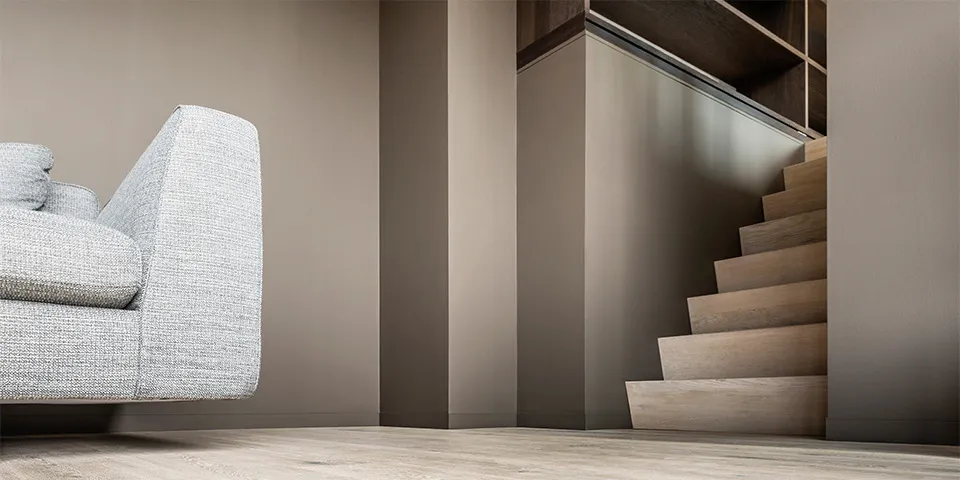
Clean interior with no visible door systems or skirting boards
The Argenta Invisible concept in practice
The owners of this private home in Waregem wanted a clean interior, with doors that blend seamlessly into the walls and skirting boards that do not draw unnecessary attention. The result is a mix of concealed swing, pivot and sliding doors that never disrupt the minimalist look. What is more, with skirting boards that are barely visible too, interior architect Thomas Nachtergaele would not compromise an inch on this point.
Swing doors without architraves or visible hinges
Thomas Nachtergaele describes himself as a ‘designer of today’. Although he is not a fan of the term minimalism, clean, modern interiors are in his DNA. And how relative is a term like minimalism when you consider that it actually demands a “maximalist” amount of work and execution? Argenta’s interior door solutions offer plenty of possibilities in this respect. Nachtergaele is pleased about that: “They are reliable, high-quality products, and I hear the same from the tradespeople I work with. They would certainly be the first to tell me if something failed to meet their quality standards or could not be installed properly.”
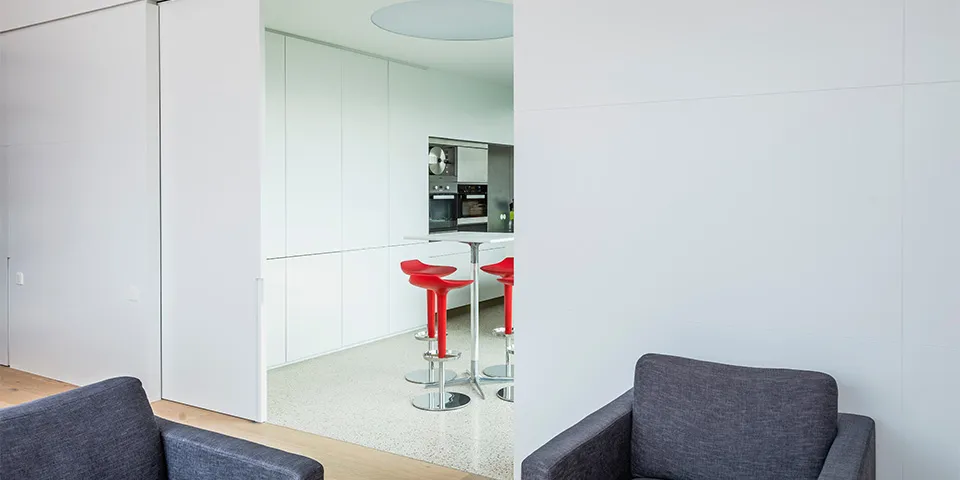
The Pro Slide sliding door between the kitchen and living room is recessed into the ceiling and disappears into the wall.
Argenta’s Invisidoor system has now become almost a standard feature in the interiors Nachtergaele designs. “You can do so much with it,” says the interior architect. “For me, products simply need to work well in all their simplicity. That is quickly confirmed by both the tradespeople who install them and the end customers.”
Dressing room: pivot door blends into the wall
According to Thomas Nachtergaele, choosing pivoting interior doors is primarily an aesthetic decision. That was also the case here with the wall separating the dressing room from the bathroom. Finished uniformly with the wall, the door looks elegant even when open. “For the sake of completeness, though, many designs feature a mix of different hardware systems for swing, pivot and sliding doors,” he adds.
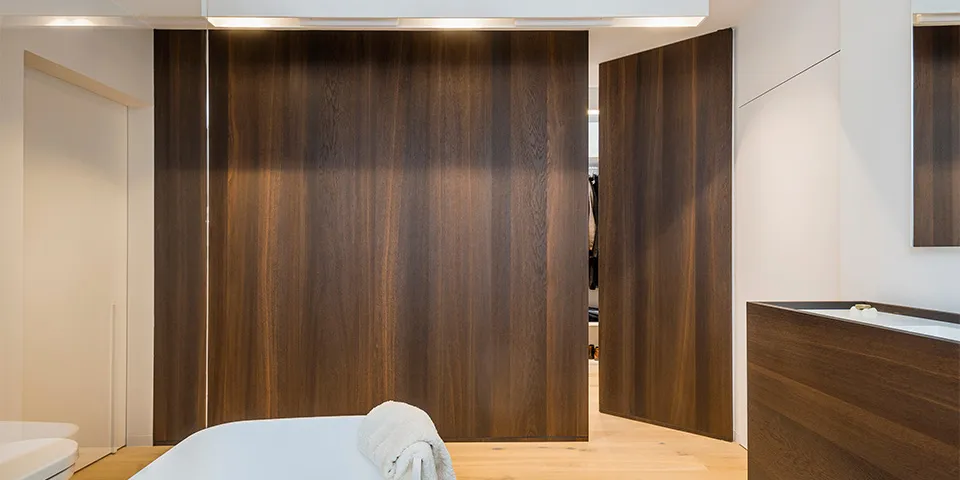
The dressing room’s pivot door blends into the wall.
Concealed sliding door leaves space for the rest of the interior
This home is no exception. To keep the large wall area between the kitchen and living room free for the rest of the interior, it made sense to have the sliding doors disappear into the walls when opened. Even with the doors open, the wall remains completely clear, while the two spaces can still be separated whenever needed.
‘Invisible’ skirting boards complete the look
“Argenta’s new ‘invisible’ adhesive skirting boards are particularly interesting because they are simple to install and finish,” says Nachtergaele. “I simply find them very appealing because they let me translate the detailing I have in mind into reality. Right through to the final finish, while keeping the overall price within bounds. Budget, of course, is also a factor. Fortunately, the finished result more than justifies the price.”
Invisiplint skirting boards were used throughout the home and are virtually invisible.
Argenta’s ‘invisiplint’ adhesive skirting boards were integrated into this home for the first time, and Thomas Nachtergaele was so impressed that he has since specified them for two other projects. “You have to take them into account from the very start of the design,” he says. “The less you want to see, the earlier in the process you need to think about how you want everything concealed. Fortunately, experience has taught me how to anticipate potential issues that may arise during installation.”
Argenta Invisible products integrated:
• Pro Slide: sliding doors between the kitchen and living room
• Invisidoor in all rooms
• Invisible hinges: in three full-height doors flush with the panelling
• Pivotica Pro: pivoting dressing room door
• Invisiplint throughout the home
Question about this story? Ask your question
Keep following this
Get an email when a new story is published. No account needed.
- ThemeImproving window and door performance
- SubjectFinishing